XQP 531B Optical De-esser: $595
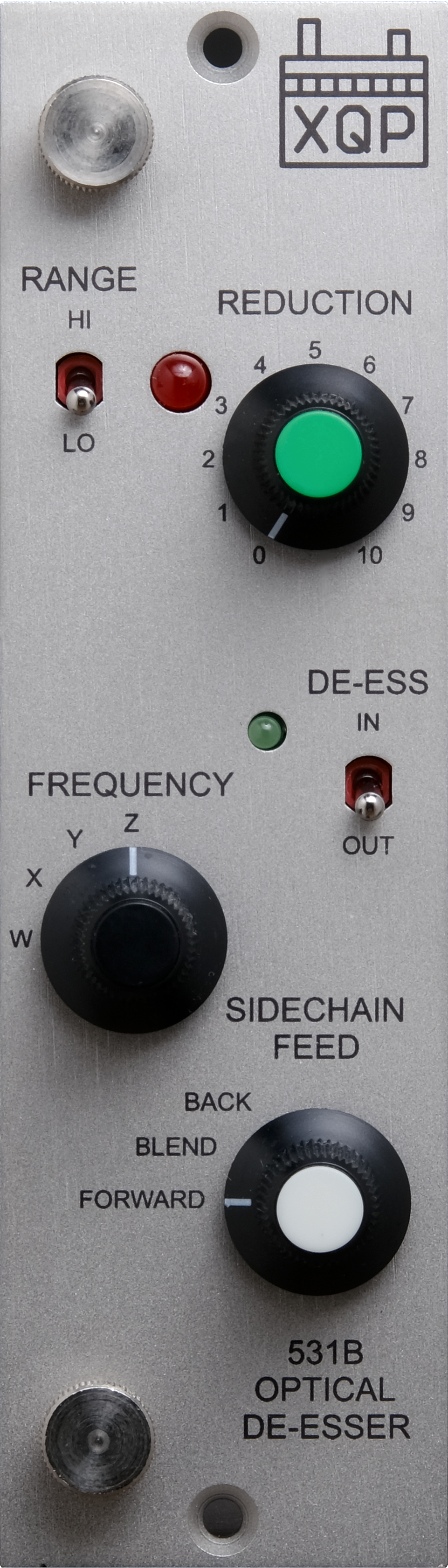
The 531B Optical De-esser is the newest version of the optical de-esser design beginning in the 1990's with the Dane #31, then picking up with the XQP 500-series modules in 2009; the 531, 531A, and 2531.
Like each one before it, the 531B is an optical limiter with a high-pass filter in the sidechain. This HPF provides a more sensible way to select sibilants to drive the gain reduction. In a voice, sibilance is a stand-alone phenomenon. It does not coincide with vowel sounds; it is in series with them. Thus when one occurs, there is nothing in the track of a higher frequency that must be excluded. So a high-pass filter allows for sibilance occurring at different frequencies to be controlled without constant twiching of the frequency control. It is adjusted to eliminate the majority of vowel sounds from triggering the action, and what remains will be sibilance. Four filter frequencies are selected by the FREQUENCY rotary switch and cover the sibilant range nicely. There is no need for terribly precise frequency selection.
This brings up an interesting point that has been the direction from day one of the design of this device. It was our early observation that the surgical approach of most de-esser designs result in devices that are difficult to adjust, and strange-sounding; often being downright destructive to more than sibilance. The object of the XQP design is one that does not call attention to itself and one that actually does more good than harm.
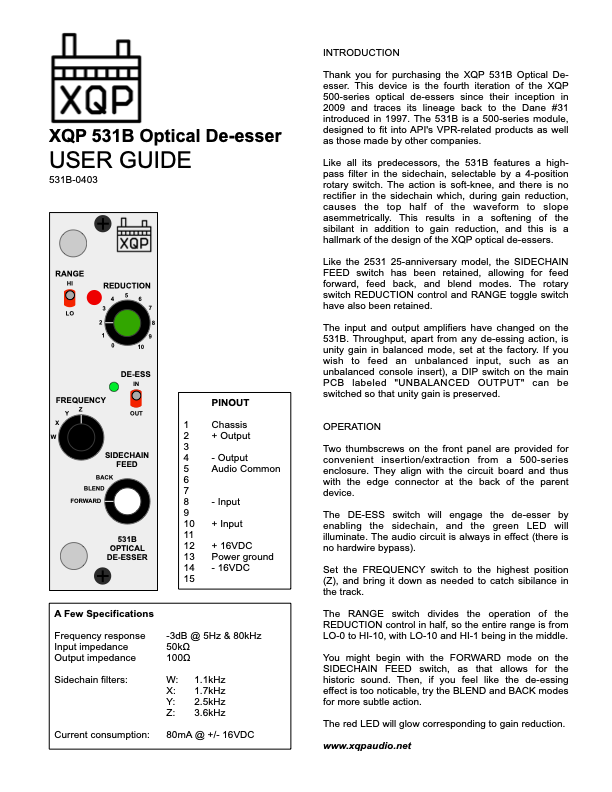 531B User Guide
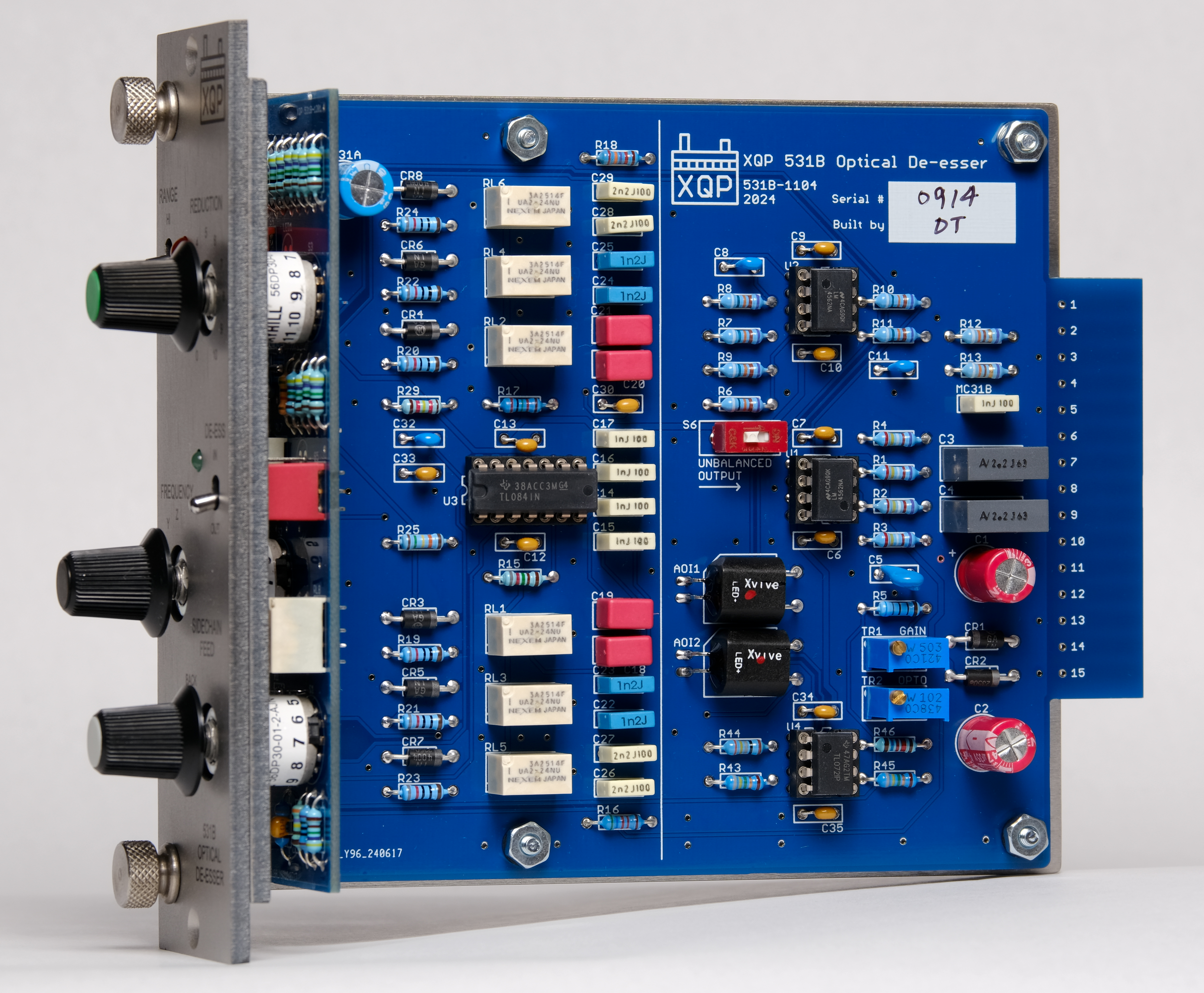
Following the filter and an amplifier, the signal drives the LED half of the VACTROL optocoupler by means of a very simple transconductance amplifier. This causes the varying voltage of the signal to control the brightness of the LED with a varying current (and current is what determines the brightness of an LED). This produces a soft-knee action that is considerably less noticable than hard knee.
Absent at this point is the normal rectifier circuit. The result, helped by a relatively quick release time of the VTL5C1 VACTROL, is a slightly asymmetrical waveform producing soft and subtle even-order distortion, similar to the kind produced by class-A circuits approaching clipping. This occurs only during gain reduction of sibilance, and the effect is a softening of the sibilance accompanying the reduction in level. The use of distortion may not seem compatible with the above statement about doing more good than harm, but it is worth a listen to understand what this distortion actually sounds like and how it affects the results.
The original design was feedforward (the signal going from the audio path into the sidechain is derived in front of the gain-control element) and remained so for many years. Then with the 2531, we added feedback and blend options with the FEED switch. This feature has been retained on the 531B, and it gives the user more options for adjusting the level of subtly possible during sibilance reduction.
Adjusting REDUCTION with a rotary switch, instead of a pot as in the olde days, allows for easy recall, if that is desired. To give accurate control, a RANGE switch divides the action of the REDUCTION switch into two halves resulting in 22 total steps with a standard 11-position rotary switch.
The large red LED mirrors the one inside the VACTROL, and its varying brightness gives a good indication of how hard the de-esser is working.
User Statements
Below are some statements from users of various iterations of the optical de-esser over the years:
Dane #31 Optical De-esser
"This Dane Optical De-esser is Fabulous! It's da Bomb! It's the box we've been looking for! It's 'da Man' of De-essers!
In just the two days the Dane #31 has been tested in Control Room 1 of the New York Bureau it has impressed everyone. It sounds so very smooth, can be activated while an interview is in progress - it is that silent! Very Versatile! Good on all voices tested thus far.
In short - we (Caryl and I) both recommend it and want it. We need two for Control Room One.
The Dane Optical De-esser is the best working and sounding de-esser I've ever heard.
Where do we sign?
Manoli Wetherell and Caryl Owen, NPR, Oct. 1998
"...All I can say - after a YEAR of trying to suppress/compress/problem-solve a frequency in my voice (hardware plus software, plus surgical specific edits), how INSTANTANEOUS the solution was with your wonderful de-esser! It just had the best freaking sound."
Ethan Persoff
XQP 531 Optical De-esser
"I've been using the XQP 531 for about two months now and I just want to say...It's Awesome!!! It's useful for more than just de-essing a vocal, but when you need a de-esser...it really, really works!!!!!!"
Tony Shepperd
"It's fantastic. Far and away the best de-esser I've ever used and I've tried a bunch, both hardware and software. I was able to set it up very easily and quickly to remove just the right amount of sibilance without overdoing it or still fearing distortion down the line."
David Boothe
"De-essers are subtle things (until all of a sudden they're painfully obvious) but the XQP 531 is a wonderfully effective & useful tool...simple to operate and surprisingly intelligent in its filtering. Bottom line - it works."
Neil Pike
"Wow, it is really fantastic. Very elegant sounding. Very natural...Reminds me of how much I hate in the box de-essing. And I didn't want to be reminded."
Rob Schnapf
XQP 531A Optical De-esser
"Best de-esser ever!...These work so well; musical and elegant - since we're talking de-essers, that says a lot!"
Pete Elia
XQP 2531 Optical De-esser (25th Anniversary Edition)
"This de-esser is spectacular. The feedback and blend modes are really useful. It’s a whole other layer to dialing it in. Between the range mode and the blend modes, you can really de-ess while keeping it natural and can avoid the sound of processing."
Rob Schnapf
